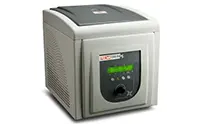
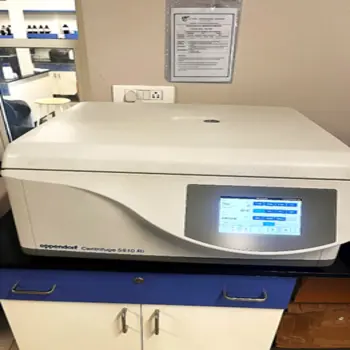
The refrigerated Eppendorf Centrifuge 5910 Ri with a wide variety of fixed-angle and swing-bucket rotors is available for use to all the students and faculty. VisioNize™ touch interface for super-fast parameter settings and quiet operations. Rotors for Eppendorf tubes, centrifuge tubes, and multiwell plates.
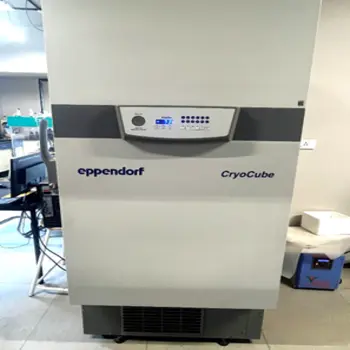
The CryoCube Ultra-Low Temperature Freezer is designed for reliable long-term storage of biological materials including nucleic acids, proteins, microbial cultures, and clinical specimens. The system maintains ultra-low temperatures to preserve sample stability and prevent degradation during extended storage.
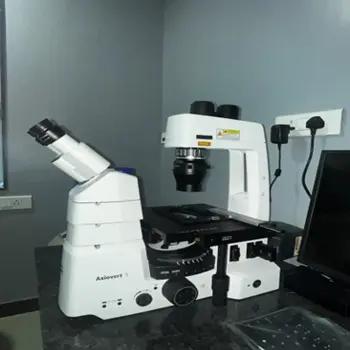
The ZEISS Axiovert 5 Fluorescence Microscope is a high-performance optical imaging system designed for advanced visualization of fluorescently labelled biological specimens. It allows detailed observation of cellular morphology, intracellular structures, and molecular localization in both live and fixed samples. Integrated with a digital imaging workstation, the system supports high-resolution image acquisition, processing, and documentation, making it a valuable tool for research in cell biology, microbiology, molecular biology, and biomedical sciences.
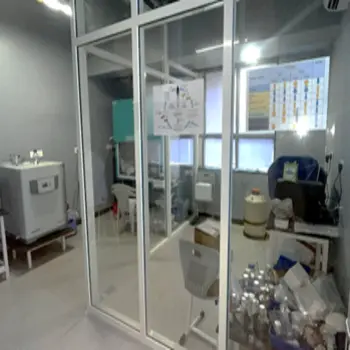
The Tissue Culture Laboratory Facility is a controlled environment designed for the maintenance, propagation, and experimental analysis of mammalian cell lines under sterile conditions, ensuring contamination-free experimental workflows.
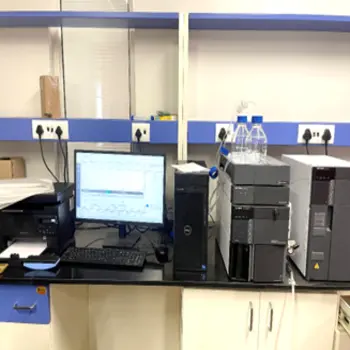
The Shimadzu High-Performance Liquid Chromatography (HPLC) System is an advanced analytical platform designed for the precise separation, identification, and quantification of chemical and biological compounds in complex mixtures. The system integrates high-precision solvent delivery, efficient degassing, sensitive detection, and automated sample handling to ensure reliable and reproducible chromatographic analysis. Instrument controls are easy to handle, with automated data acquisition, and comprehensive analytical data processing.
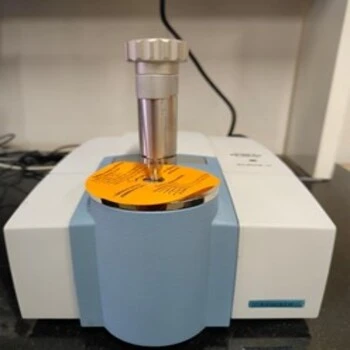
The Bruker ALPHA II FTIR Spectrometer is a compact, high-performance analytical instrument designed for rapid and reliable infrared spectroscopic analysis of a wide range of materials. FTIR can be used for molecular characterization by measuring the absorption of infrared radiation by chemical bonds within a sample. This instrument enables direct analysis of solids, liquids, and semi-solid samples with minimal or no sample preparation, significantly improving analytical efficiency.
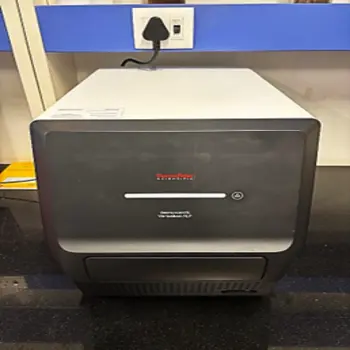
The Thermo Scientific™ Varioskan™ ALF Multimode Microplate Reader is a versatile and high-performance analytical platform designed for a wide range of life science applications. The plate reader supports multiple detection technologies including absorbance, fluorescence intensity, and luminescence. Its modular design and automated functionality allow researchers to perform diverse assays efficiently while maintaining high throughput and analytical accuracy. The Varioskan ALF system is widely used in molecular biology, cell biology, drug discovery, and biochemical research laboratories for quantitative analysis and screening applications.
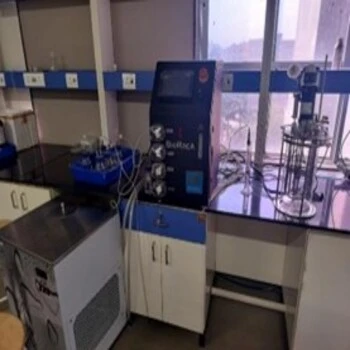
The manufacturing process begins with cell culture, where cells grown in the laboratory are scaled up to bioreactors. At DYPIU, two bioreactors are used to maintain the specific environment required for optimal cell growth. In bioreactors, critical parameters such as temperature, pH, nutrient concentration, and oxygen levels are strictly controlled.
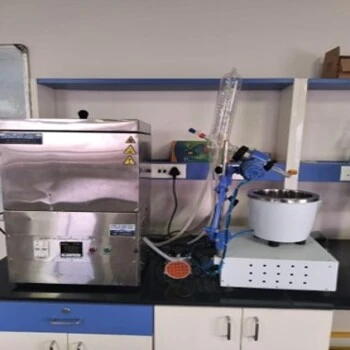
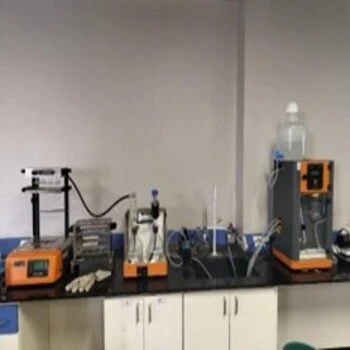
A rotary evaporator is used to efficiently and gently evaporate solvents from samples. A rotavap instrument is essential for isolating and concentrating solutes by removing the solvent, resulting in the purification of the desired molecule.
Kjeldahl Apparatus is an analytical instrument used for determining nitrogen content in organic and inorganic substances. The Kjeldahl method determines nitrogen by converting it into ammonium sulfate through digestion, followed by distillation and titration.
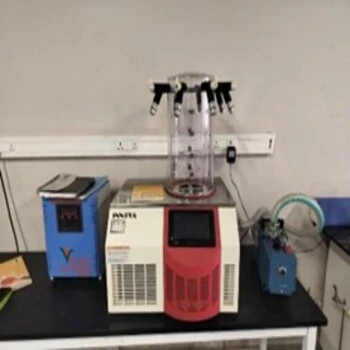
A lyophilizer is a specialized piece of equipment used in biology, biotechnology, pharmaceutical, and food industries for drying heat-sensitive materials. The freeze-drying process involves freezing the material and then removing the ice by sublimation, where ice transitions directly into vapor without passing through the liquid phase.
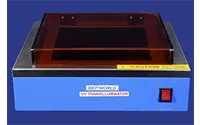
UV transilluminators are used in molecular biology laboratories to view DNA or RNA that has been separated by electrophoresis through an agarose gel. Exposing the stained gel to a UV light source causes the DNA to fluoresce and become visible. These instruments are useful for viewing samples to size a PCR product, purify DNA segments after a restriction enzyme digest, quantify DNA, or verify RNA integrity after extraction.
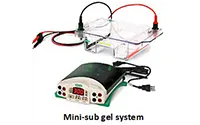
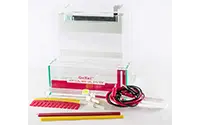
Gel electrophoresis is a technique used to separate DNA fragments according to their size. DNA samples are loaded into wells (indentations) at one end of a gel, and an electric current is applied to pull them through the gel. DNA fragments are negatively charged, so they move towards the positive electrode.
Blotting equipment includes all components required for protein transfer from gel to membrane and subsequent membrane processing. Western blotting is a widely used technique by research and clinical labs to detect proteins with their specific antibody. Blots require an apparatus, or blotter to transfer the gel to membrane under wet, dry or semi-dry conditions. Transfer protocol depends on type of protein, gel thickness, and type of membrane.
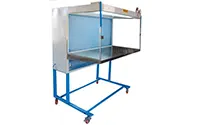
A laminar flow cabinet or tissue culture hood is a carefully enclosed bench designed to prevent contamination of semiconductor wafers, biological samples, or any particle sensitive materials. Air is drawn through a HEPA filter and blown in a very smooth, laminar flow towards the user.
Laminar flow hoods are ventilation devices used within the lab to provide an aseptic work area that helps protect both the laboratory personnel and the materials they are working with.
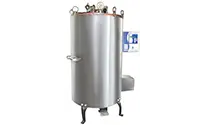
An autoclave is a machine that uses steam under pressure to kill harmful bacteria, viruses, fungi, and spores on items that are placed inside a pressure vessel. The items are heated to an appropriate sterilization temperature for a given amount of time.
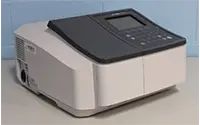
UV/Vis spectroscopy is routinely used in analytical chemistry for the quantitative determination of different analytes, such as transition metal ions, highly conjugated organic compounds, and biological macromolecules. Spectroscopic analysis is commonly carried out in solutions but solids and gases may also be studied.
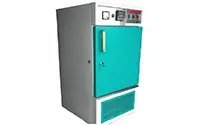
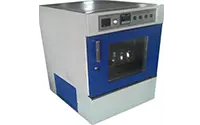
BOD Incubator (Bio-Oxygen Demand) are used to maintain temperature for test tissue culture growth, storage of bacterial cultures and incubation where high degree of constant temperature accuracy is required. BOD Incubators provide with accurate conditions and uniformity throughout the chamber.
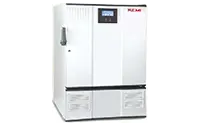
Deep-freezing is an industrial technique which involves cooling rapidly and brutally (a few minutes to an hour) food by exposing them intensely to temperatures from -30 째 C to -50 째 C, until the product core temperature reaches -18 째 C. With this process, the water contained in the cells is finely crystallized. Deep freezers are the testing equipment that are used to biological samples, proteins, enzymes, chemical reagents, etc. for a long period of time.
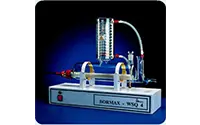
Water distiller is a machine which is used to purify water using distillation process, which is related to first boiling impure water after that collecting condensed water in a separate container. This distilled water is used in laboratory, organic chemistry lab, clinic, fermentation and medical industry etc.
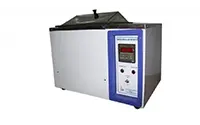
Utilisations include warming of reagents, melting of substrates or incubation of cell cultures. It is also used to enable certain chemical reactions to occur at high temperature. Water bath is a preferred heat source for heating flammable chemicals instead of an open flame to prevent ignition.
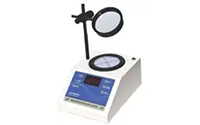
Digital Colony Counter is designed for quick and accurate counting of bacterial and mould colonies in petri dishes. Feature packed and easy to use, this is an indispensable bench top tool for the busy microbiologist. It is designed for rapid and accurate counting of bacterial and mould colonies.
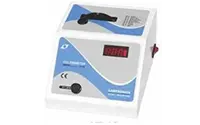
A digital colorimeter is an instrument used to measure the absorbance of wavelengths of light at a particular frequency (colour) by a sample. Digital colorimeters are widely used across different work areas including, environmental testing, clinical diagnostics, pharmaceutical analysis, and biochemistry. In particular, a portable colorimeter can be used for on-site environmental analyses. Similar to spectrophotometers, laboratory colorimeters are used to determine the concentration of a known solute in a sample since the concentration of a solute is proportional to the absorbance. The wavelength filter used is very important since the wavelength of light that is transmitted by the colorimeter has to be same as that absorbed by the sample.
An incubator is a device used to grow and maintain microbiological cultures or cell cultures. The incubator maintains optimal temperature, humidity and other conditions such as the CO2 and oxygen content of the atmosphere inside.
An incubator shaker (or thermal shaker) can be considered a mix of an incubator and a shaker. It has an ability to shake while maintaining optimal conditions for incubating microbes or DNA replications.
Refrigerated centrifuge works on the concept of sedimentation principle by holding up the sample tubes with a capacity of 2ml, 10ml and 50ml in rotation around a fixed axis. In this, the centripetal force causes the denser substances to separate out along the radial direction in the bottom of the centrifuge tube.
A centrifuge is a laboratory device that is used for the separation of fluids, gas or liquid, based on density for RNA, DNA and protein isolation. Separation is achieved by spinning a vessel containing material at high speed; the centrifugal force pushes heavier materials to the outside of the vessel.
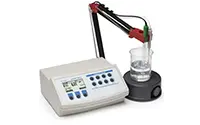
PH meter, electric device used to measure hydrogen-ion activity (acidity or alkalinity) in solution. Fundamentally, a pH meter consists of a voltmeter attached to a pH-responsive electrode and a reference (unvarying) electrode.
Knowledge of pH is useful or critical in many situations, including chemical laboratory analyses. pH meters are used for soil measurements in agriculture, water quality for municipal water supplies, swimming pools, environmental remediation; brewing of wine or beer; manufacturing, healthcare and clinical applications such as blood chemistry; and many other applications
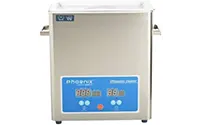
Sonication is the act of applying sound energy to agitate particles in a sample, for various purposes such as the extraction of multiple compounds from plants, microalgae and seaweeds. Ultrasonic frequencies (>20 kHz) are usually used, leading to the process also being known as ultrasonication or ultra-sonication.
Sonication is a process in which sound waves are used to agitate particles in solution. Such disruptions can be used to mix solutions, speed the dissolution of a solid into a liquid (like sugar into water), and remove dissolved gas from liquids.
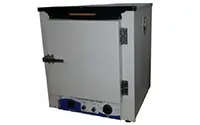
Hot air ovens are electrical devices which use dry heat to sterilize. They were originally developed by Pasteur. Generally, they use a thermostat to control the temperature. Their double walled insulation keeps the heat in and conserves energy, the inner layer being a poor conductor and outer layer being metallic.
Laboratory ovens are ovens for high-forced volume thermal convection applications. These ovens generally provide uniform temperatures throughout. Process applications for laboratory ovens can be for annealing, die-bond curing, drying, Polyimide baking, sterilizing, and other industrial laboratory functions.
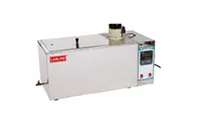
A water bath is laboratory equipment made from a container filled with heated water. It is used to incubate samples in water at a constant temperature over a long period of time. Most water baths have a digital or an analogue interface to allow users to set a desired temperature, but some water baths have their temperature controlled by a current passing through a reader. Utilisations include warming of reagents, melting of substrates or incubation of cell cultures.