
header bg
PhD
Program Overview

DYPIU supports interdisciplinary research activities cutting across various disciplines e.g. Engineering including Computer Science; Bioengineering/Biosciences, Management, Journalism and Mass communication. With focus on problem solving, discipline is not a barrier for Ph.D. work.

Admissions are open to students for 2023-24 academic year.

Financial assistance may be available in the form of Teaching Assistantship to the tune of @ INR 31K-40K pm

Active research areas at DYPIU
Biosciences and Bioengineering

Biomedical Engineering, Cell and Tissue Engineering, Health Care Diagnostics and Therapy, Computational Biology and Medicine.

Computer Science Engineering

Brain Computer Interface (BCI), Artificial Intelligence/Machine Learning, Digital Fabrication and Advanced Manufacturing, Image Processing, IOT

Engineering

Alternate Fuel and Energy, Specifically, Hydrogen, Plastic Fuel, CNG, Alternate Fuel

Applied Mathematics and Statistics
Management and Entrepreneurship

Human Resource Management, Business Analytics, Fintech

Mass Communication

Communication, Advertising, Public Relations, Journalism, Sociology

Details of Research Fields

A lot of computational approaches are being used by the researchers at the University to develop strategies to tackle pandemics using COVID as an example and using multi-pronged strategy like designing peptides, repurposing drugs, designing multifunctional epitopes etc. Another area of importance is antimicrobial resistance strategies. Design and development of therapeutics, computational modelling, Vaccine design, AI and Molecular Dynamics.

Brain computer interface using electrical activity in the brain to monitor behaviour, learning, and manage consciousness. Use of BCI to help compromised individuals and various assistive technologies to aid in special needs are in progress.

Tissue Engineering strategies for developing lab on chip models, and Using AI for developing novel biomaterials and regenerative medicines are some of the areas being pursued.

Nanomaterials for use in diagnostics, therapy, genetic manipulation and theragnostic adding to Personalized medicine

Quantum Algorithms for Nuclear Fusion and Quantum Machine Learning for Near Term Quantum Computers are some of the works going on in the domain of Quantum computations

In the process of environment care, DYPIU is engaged in projects related to reduction in carbon emission, vertical farming, waste management and clean energy generation schemes.

Smart health care practices involve better diagnostic approaches and prevention strategies involving biological, physical and electronic systems.

AI/ML is being used in various different areas to solve problems and achieve faster accurate outputs where it is humanly difficult. From driverless cars to how doctors identify and treat diseases, AI is poised to forge a future of endless new possibilities. At DYPIU, we are working on various AI problems including Foundational AI Research, Convolutional Neural Networks.

Nuclear fusion mimics the natural reactions occurring within the Sun, and has been a goal of scientists around the world since the 1950s. The process has been hailed as the “holy grail” of clean energy, as it is almost limitless, requires no fossil fuels, and leaves behind no hazardous waste. Nuclear fusion is considered the holy grail of energy production. However, in addition to this, utilization of plasma-based processes to manufacture artificial diamonds has been achieved. A group of experts of plasma physics are working in DYPIU for a variety of applications.

Virtual technologies to synthesize and create art forms and facilities.

The emphasis is on developing smart robotics to help in surgical operations on Human body.

The focus on energy is to create and utilize green and clean energy for the future and to conserve and reverse the environmental damages. Nuclear fusion is one such possibility. A Project supported by US investors called “Project Sanlayan '' was started at DYPIU as the first private project of this kind in the country.

Chronic health problems and solutions, as the name suggests, deal with nagging debilitating problems in metabolism and health. A microbiome lab has been established in DYPIU as part of Project Sushrusha. In parallel other relevant work is going on to help in this project.

Some of the key areas of research in Advanced Manufacturing include the development of Additive Manufacturing (3D printing) for applications in several areas such as Prototype development, Technology Development Materials in the fields of Engineering, Architecture, Design, Fine Arts.

  • Human Resource Management

    Research is proposed to be initiated in areas of, Digital Employee engagement, Talent management, Social Media recruitment processes.

  • Fintech

    Technology in Finance has brought a revolution in business operations. Fintech research is proposed in areas like Cyber Security, Regulatory Frameworks, studying the impact and potential of Blockchain on securities transactions, Fintech Platforms and strategies.

  • Marketing

    Digital Business is the way of new business accompanying and impacting everything in our lives today. Customers and Businesses both perceive the world through online lenses. This has paved the way for research in Digital consumer Behaviour, Using Artificial Intelligence to enhance digital marketing, impact of blockchain on Digital Advertising, applications of Marketing Analytics tools in deciphering consumer psychology etc.

Communication, Advertising, Public Relations, Journalism,

  • Gender: The scholars will do In-depth understanding of gender as a social construct, the different gender roles and their creation, representation of gender in different areas, theories and concepts of gender, third gender, feminism and the stages and waves.

  • Cinema and Society: Over the years, Cinema has achieved an academic status. The research will foster original thought and intellectual initiative. It will cultivate media-literate scholars capable of navigating a variety of mediums, geographic contexts, and historical eras, from early cinema to the digital era.

  • Theories and Concepts of Communication: Research in Communication will analyse emerging and enduring forms of public communication and the institutional and economic conditions that sustain them. They will employ a range of research methods, including ethnography, textual and historical analysis, and political economic approaches to media industries.

Why choose PhD at DYPIU?

Emphasis is on applicability to real-life issues and to impart a practical understanding of how research and enquiry are used to create and interpret knowledge in their field while helping achieve a larger goal

The program prepares students with a thorough knowledge of different fields cutting across multiple disciplines and develops outstanding researchers who have a deeper understanding of the new knowledge that they create and the issues they study

With a comprehensive understanding of scientific methods and techniques applicable to their own research and students will make an original contribution to the chosen area of interest.

The Doctoral Program leading towards the award of the Degree of Doctor of Philosophy (PhD) provides the students with an opportunity for a career in Academia, Industry, Research & Development establishments along with other possibilities such as entrepreneurship.

Program Learning Outcomes
  • PhD graduates from DYPIU will have a thorough knowledge of the literature and a comprehensive understanding of scientific methods and techniques applicable to their own research and make an original contribution in the chosen area of interest
  • They will be able to demonstrate originality in the application of knowledge, together with a practical understanding of how research and enquiry are used to create and interpret knowledge in their field
  • The program prepares students with a thorough knowledge in different fields cutting across multiple disciplines and develops outstanding researchers who have deeper understanding of the new knowledge that they create and the issues they study
  • The Doctoral Program leading towards the award of the Degree of Doctor of Philosophy (Ph.D.) provides the students an opportunity for a career in Academia, Industry, Research & Development establishments along with other possibilities such as entrepreneurship.
Academic Requirements
Category Minimum Total Credits Minimum Course Credits Minimum Research Credits Minimum Residency* (Semesters) Typical Duration (Years)
PhD – after BTech/MSc 118 22 96 8 4-6
PhD – after MTech/MPhil/MCA 114 18 96 6 3-5
PhD Sponsored – after MTech/MPhil 144 24 96 1 3-5
PhD Sponsored – after BTech/MSc/MCA 96 33 48 2 4-6

* The minimum residency requirement may be lowered under exceptional circumstances. For details refer above table.

Residential Requirement

The minimum residency requirement for the PhD program is listed in above Table . During the period of residency, the student should be available on DYPIU campus for academic and research activities during all working hours of the institute. Moreover, the student should have registered for a total of at least 4 credits during the regular semester.

Academic Advising

A student entering the PhD program will be advised in the selection of courses/faculty mentor/supervisor by the University Research Coordinator. The student is then expected to obtain consent from a member of faculty at DYPIU to supervise his/her PhD thesis. This must be done before the end of semester in which the student clears the PhD comprehensive examination.

Qualifying Examination
  • Students registered for the PhD Program must pass a qualifying examination that is designed to test the overall skill sets of the student in the relevant subjects.
  • Students admitted with for PhD program may appear in the qualifying examination earliest by the end of First semester itself, but must pass the examination before the end of the second semester after their first registration.
  • Students should obtain a minimum 50% marks to successfully clear the qualifying examination. Students will get two chances to pass the qualifying examination. Those who fail to clear the qualifying examination in the second attempt will have to discontinue from the Program.
Financial Assistance

All those admitted as full-time PhD students will be eligible for financial support in the form of Teaching Assistantships (TA)/Research Assistantships (RAs). The assistantship is Rs. 31,000 per month till the end of the semester when the candidate clears the qualifying examination and completes the course work, whichever is later.

For the subsequent period, the assistantship gets revised to Rs. 40,000/- per month. A candidate can avail of the assistantship for a maximum duration of four years after passing the qualifying examination or clearing of Synopsis, whichever is earlier. The responsibilities associated with the teaching/research assistantship include conducting laboratory courses and tutorials for undergraduate students and assisting in teaching, research projects, and academic administration as assigned.

Research Progress Evaluation

Once a PhD student clears his/her qualifying examination, Dean (Research and Development) will form a Research Progress Evaluation (RPE) committee for assessing the PhD student’s progress in every semester. The PhD student is required to present his/her progress in the form of Research Progress Seminar (RPS) to the RPE committee. Students are also required to give a seminar in a topic not related to their research topic to broaden their knowledge. The RPE committee will assess the progress report of the student in the form of Satisfactory and Unsatisfactory, and will accordingly advise the student.

Admission

Admission to the PhD program is through institutional entrance exam/interview or both as decided by the University Selection committee. The date of entrance exam/interview will be intimated to the students. At the time of interview students can discuss their prior research experience and future research interests.
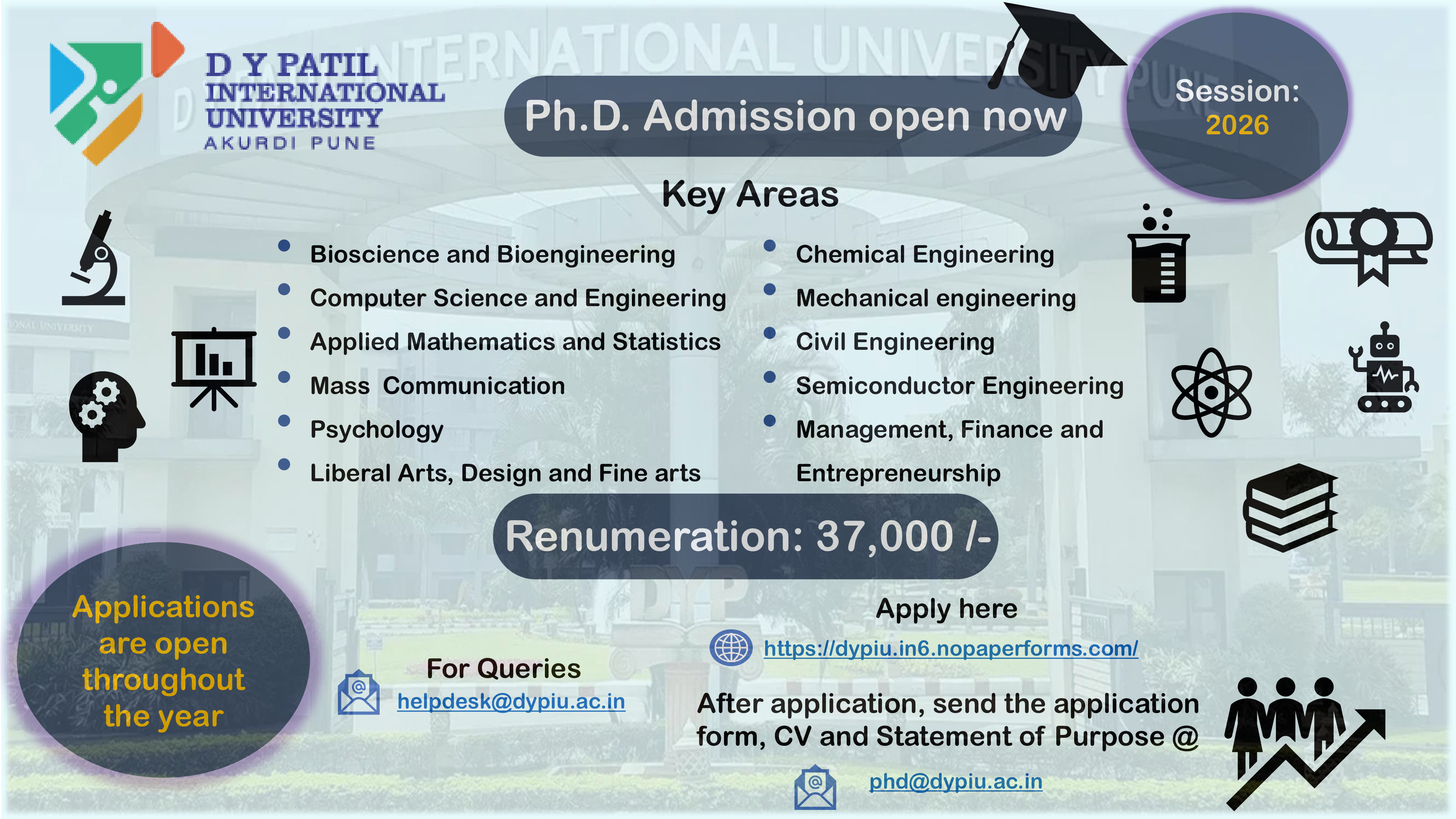
  • First fill your application form here.
  • Attach Statement of Purpose (SOP) and your CV to the form.
  • Our counsellor with organize your interview with the selection committee where you would need to make a presentation of your prior research experience and future research plans for your PhD
PhD Regulations
At DYPIU, we are addressing the real-world challenges related to healthcare, science and technology and management and entrepreneurship. We aim to produce meaningful research which aims to solve the problems of today and the future. Our research interests are driven by the real-life problems that one faces in everyday life and their solutions cross disciplines to create new ideas. Through the combined strength of our schools and their faculties, we aim to push boundaries and aid in accelerating the transition of the society and world into the future.
Following are some of the research areas of our courses:
1. Biosciences and Bioengineering

We are working towards solving healthcare problems with wearable and assistive technology. Currently our research focuses on designing healthcare solutions for drug delivery in chronic and acute health conditions. We are also developing adaptive, and rehabilitative devices for people with disabilities or the elderly population.

Looking at epithelial healthcare, we are studying the response of epithelial cells on biomaterials with varied physical and chemical properties. Additionally, in combination with microfluidics, we aim to develop drug testing platforms based on differentiated stem cells

We are working on biomaterials/nanomaterials based therapeutics in the field of Biomedical Engineering and Biomedical Sciences. We also work in the field of personalised medicine and holistic healthcare.

We are working on basic and applied scientific research topics in the field of Biotechnology. We are capable of producing advanced knowledge to launch cutting edge technologies pertinent to biotechnology, with special emphasis on the Agriculture and Environmental sector. Also, we aim at creating awareness about potential applications in the field of Biotechnology with emphasis on the socio-ethical implications.

We are working on modern ways of farming which involves vertical farming, hydroponics, aeroponics and aquaponics. We are also finding modern ways of wheatgrass cultivation for juice production.

Precision Medicine and Healthcare Research involves research on the holistic system of medicine and functional medicine. The focus is on patient centered care. In view of this some areas of research become very vital such as the gut microbe analysis, the leaky gut, Internal cleanse and detoxification processes. The treatment strategies include treating deficiencies and functional nutrition. The aim is to combine them with artificial intelligent systems for future healthcare, for example Artificial Intelligence for Personalized medicine and healthcare.
2. Computer Science and Engineering

A lot of difficulties appear in old age where it becomes difficult for them to perform day to day life. A large proportion of children and adults also face disabilities in their lifetime. Some may be congenital and some acquired after certain accidents or injuries. We need to understand the needs of elderly and physically disabled people. The aim is to improve their quality of life and assist them carry out their day to day life activities. Along with physical they may also face neurological and psychological disorders. We need to address factors such as Physical Security, Medical Emergency, Communication Needs etc of the Elderly and Persons with Disability. Networked Embedded Systems were used to develop a number of assistive devices based on body, brainwave and touch sensor to help persons with severe disability. We could use hand gestures to control surrounding objects like TV, Light, Fan, Computer etc for those with restricted finger movement. We used various possible ways of taking inputs from the body as well as the brain. Our work of assistive technology based on brain computer interface, created a new set of possibilities to provide means of communication and other functionality to those with loss of movement of limbs as well as voice. We were able to help those with learning disabilities as well as those in vegetative state. We developed software to use touch screen based tablets to help many children with autism and other cognitive behavioural disorders to communicate, control the environment and learn.

The research area basically focuses on different image processing and computer vision applications on various aspects of practical day to day problems. One interesting problem is remote aerial imaging technique which can be used for surveillance purposes. Moreover, it deals with the LTAP (lighter than air platform) mounted different imaging devices (optical, IR, NIR) to detect and classify objects. The imaging project can be extended to mapping and robotic odometry for virtual reality or augmented reality. In this case, the robot can be taught the different emotions which have been detected and learned by gesture and emotion recognition. The other current scenario, in the era of Instagram and Facebook , the world of ‘image’ is providing more data than text. Hence, text mining is gradually being replaced by image and acoustic mining. This surveillance process could be useful to detect one area of interest from some short video which contains a number of image frames and sound. We are also dealing with Optical character recognition (OCR) of Indian languages where we try to digitize the old literature (old books, texts) with different Indian fonts automatically.

Robot mounted 2D and 3D cameras and other different visual input based object detection and mapping based research projects are developed under this project. Currently, we are looking at SLAM based mapping and tracking systems for different robots like automated guided vehicles (AGVs) and automated UAVs.

Owing to the growing needs and the importance of advancement of in the areas of space research we are in the process of developing drones for Precision Agriculture, Environmental Monitoring, Forestry, Oil and Gas, Oceanography, Infrastructure Monitoring, Transportation and Logistics, Security, Events etc Another area of focus would be the development of Satellites like NanoSat, PicoSat, FemtoSat Outer Space Technology Lunar Rover, Lunar Habitat and Exploration.

Some of the key areas of research in the Center for Advanced Manufacturing include the Development of Additive Manufacturing (3D printing) for applications in several areas such as Prototype development, Technology Development Materials in the fields of Engineering, Architecture, Design, Fine Arts.

We are developing content based on virtual and augmented reality for education and skill development and also creating adaptive learning techniques backed by artificial intelligence for distance learning technology.

To aim is to develop BCI based systems and Artificial Intelligence (AI) technology for several applications. Make use of neurosynaptic chips based applications for Audio and Visual Recognition.

This field is a bridge among Mechanical, Electrical, Computer Science and other engineering domains. After substantial progress in the area the emergence of Mechatronics Engineering has been reported. The research in the Control and automation deals with system design, system dynamics, stability analysis, controller design, modelling of the systems. The viewpoint for systems is through mathematical models. At DYPIU we have high end interdisciplinary domains like Artificial Intelligence and Machine Learning, Robotics & AI, which holds the cutting edge developments of control and automation. This strengthens the possibilities of quality research in control and automation. Some key sub areas of control and automation are as follows: Robust Control, Biological Systems, Finite Element Method, Reinforcement Learning Control, Approximate Dynamic Programming, Simulation and Control, Model Order Reduction, Cyber Physical Systems, Guidance and control, Dynamical systems, Intelligent control, Robotics, Sliding mode control, Nonlinear Control, Computational Methods for modelling, Mechatronics, Discrete Time Systems, Differential Games, Distributed Parameter Systems, Adaptive Control of uncertain Nonlinear systems, System Identification. The research in these areas, and sub areas of control and automation requires a good understanding of mathematics. Having a good hand at programming is a plus. The work combines the ample amount of theoretical and practical exposure.
3. Management and Entrepreneurship

With the change in Business Environment, and digitization of business, the scope and role and contribution of Human Resource management has changed into innovative practices which are an interplay of technology, process , people. If rightly integrated and implemented the phenomena can also be used vastly to improve HR experiences for management as well as employees. This can have an huge impact on business intelligence, knowledge management and productivity . Research is proposed to be initiated in areas of, Digital Employee engagement, Talent management, Social Media recruitment processes.

Utilization of Management Information Systems (MIS), HRIS, ERP-HR, Business /HR analytics, People Analytics, AI and Machine learning as a platform for navigating the future workplaces.

Technology in Finance has brought a revolution in business operations .The startups in fintech are posing challenges for regulators as well as market participants, creating a need to balance innovation with risks. Fintech research is proposed in areas like Cyber Security, Regulatory Frameworks , studying the impact and potential of Blockchain on securities transaction, Fintech Platforms and strategies.

Digital Business is the way of new business accompanying and impacting everything in our lives today. Social and online media like Facebook, Amazon are ways we influence, buy or sell our products. Customers and Businesses both perceive the world through online lenses. This has paved the way for research in Digital consumer Behavior, Using Artificial Intelligence to enhance digital marketing, impact of blockchain on Digital Advertising, applications of Marketing Analytics tools in deciphering consumer psychology etc.
Eligibility Criteria
  • 4-year undergraduate (B.E./B.Tech.) or a Master’s degree in relevant disciplines with a minimum of 60% marks in their eligibility examinations or an equivalent CGPA.
  • Candidates with a high score in national/state level qualifying exams such as NET (UGC, CSIR, ICMR, DBT, ICAR), JAM, PERA, CAT, XAT, MAT, ATMA, NMAT, GATE, or GRE will be preferred
  • Candidates may avail of any existing fellowship during PhD program
  • Due consideration would be given to candidates with experience as research assistants/fellows working with recognized research institutions/industries during the admission process
Fees Structure
  • Tuition fee - Rs. 75,000 per Semester
  • Registration Fee - Rs. 2,500 per Semester
  • Caution Deposit - Rs. 10,000 (Refundable at the end of the program)

* Semester fees may change as per approval from Fee Fixation Committee

* Financial assistance may be available in the form of Teaching Assistantship to the tune of @ INR 31K-40K pm

FAQ's

  • Fill the application form available online at www.dypiu.ac.in and submit by paying Registration fees Rs. 1000/- (Non- Refundable).
  • The application form can be obtained from the admission cell of the DYPIU by paying non-refundable fees Rs. 1000/-

  • 4 year undergraduate (B.Tech./B.E. (all disciplines)) or a postgraduate in Management, Engineering, Science or Arts with a minimum of 60% marks in their eligibility examinations or an equivalent CGPA
  • Candidates with self-funded fellowships will be preferred
  • Candidates with a high score in other qualifying exams such as NET (UGC, CSIR, ICMR, DBT, ICAR), JAM, PERA, CAT, XAT, MAT, ATMA, NMAT, GATE, or GRE will be preferred
  • Consideration will be given to students with relevant industry/academic experience. Applicants are encouraged to include hands-on project experience, if any, along with their application
  • Full-time research associates or fellows working with recognized research institutions and those who have publications in refereed journals or conference proceedings will be appreciated

Duration of the course is 4-6 years, depending on the research topic and efforts involved.

  • Tuition fee - Rs. 75,000 per Semester
  • Registration Fee - Rs. 2,500 per Semester
  • Caution Deposit - Rs. 10,000 (Refundable at the end of the program)

Yes, It is a full-time course with Teaching Assistantship. The assistantship is Rs. 31,000/- per month till the end of the semester in which the candidate clears the qualifying examination and completes the course work, whichever is later.

Admission to the PhD program is through institutional entrance interview.

Along with Application Form Send Statement of Purpose, and CV to phd@dypiu.ac.in

Apply Now
Prospectus
Whatsapp