
header bg

Center of Excellence – Indian Knowledge System

Center of Excellence – Indian Knowledge System

Department Profile

about

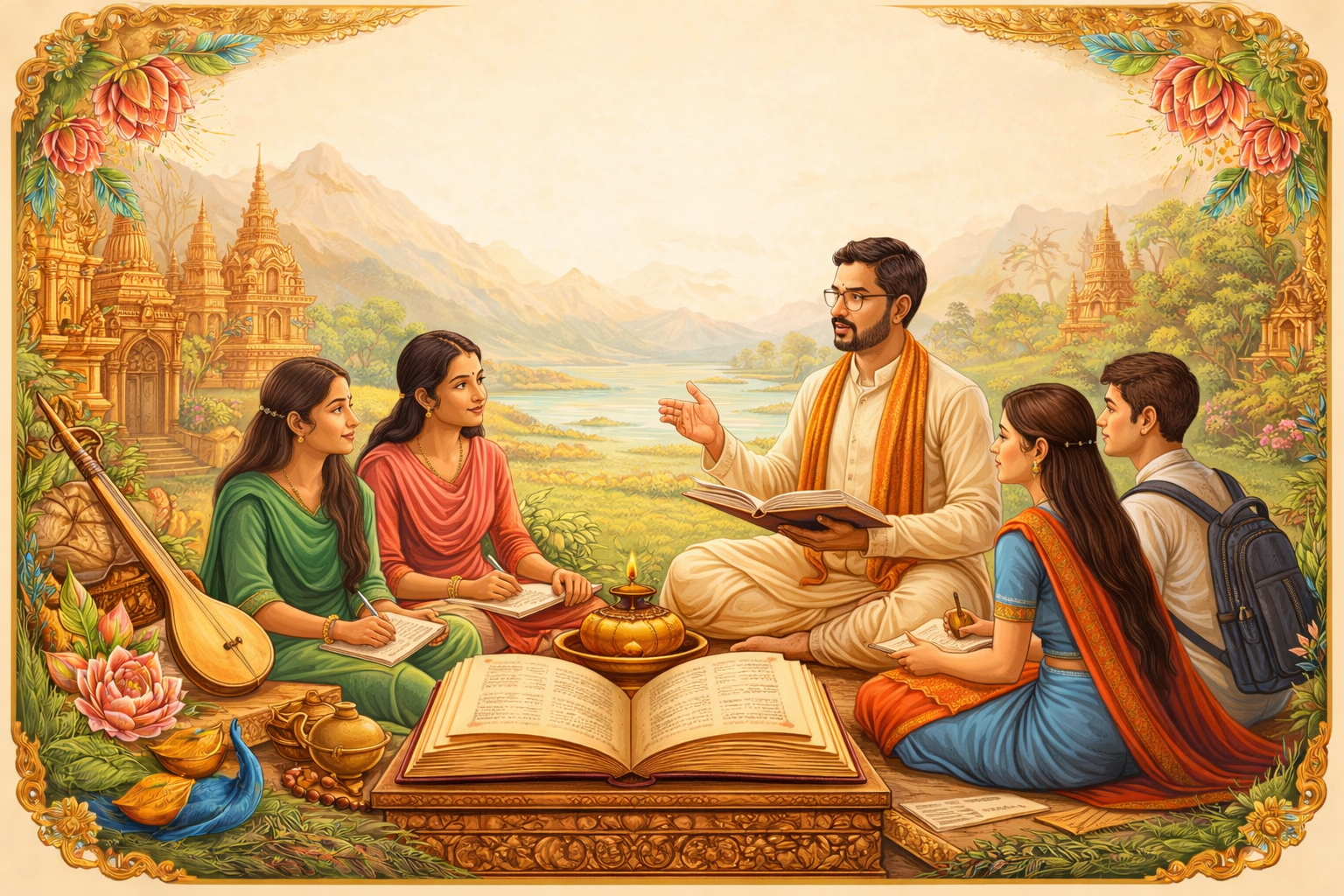
Center of Excellence - Indian Knowledge System (CoE-IKS), DYPIU serves as a dedicated academic hub for integrating India’s rich intellectual traditions with contemporary higher education. Aligned with the vision of the National Education Policy (NEP) 2020, the Centre adopts a rigorous, outcome-based approach, embedding IKS across teaching, learning, and research. It seeks to foster a nuanced understanding of classical Indian thought while enabling its meaningful application in modern academic and professional contexts.

Read More

Vision

To emerge as a leading academic centre for advancing Indian Knowledge System through outcome-based, interdisciplinary, and research-driven education, fostering a deeper engagement with India’s intellectual heritage while contributing to global knowledge systems. The Centre envisions nurturing ethically grounded, culturally rooted, and globally competent individuals who integrate traditional wisdom with contemporary innovation for the betterment of society.


Mission

  • Center of Excellence - Indian Knowledge System (CoE-IKS), DYPIU aims to embed India’s knowledge traditions within academic practice through applied learning and research, while cultivating reflective thinking and value-based education;
  • Read More

Department Objectives

Core Values
  • To integrate Indian Knowledge Systems within academic programmes through structured and applied learning
  • To encourage scholarly inquiry into classical Indian texts and their contemporary relevance
  • To provide platforms for academic dialogue, expert interaction, and experiential engagement
  • To support faculty and student development in areas related to IKS
  • To promote awareness and appreciation of India’s intellectual and cultural heritage

Department Outcomes

Core Values
  • Students demonstrate an informed understanding of Indian knowledge traditions in academic and professional contexts
  • Enhanced critical thinking and ethical decision-making abilities
  • Ability to relate traditional knowledge with contemporary issues and practices
  • Increased participation in research, discussions, and experiential learning initiatives
  • Development of culturally aware, responsible, and socially engaged graduates

A New Academic Paradigm

The National Education Policy (NEP) 2020 has ushered in a transformative shift in Indian higher education by foregrounding Indian Knowledge Systems (IKS) as an integral part of academic learning. Moving beyond colonial-era frameworks, the policy recognises India’s vast intellectual heritage, spanning philosophy, science, medicine, arts, governance, and ecology, as a dynamic and relevant knowledge tradition.

At D Y Patil International University (DYPIU), Pune, this vision is actively realised through Center of Excellence - Indian Knowledge System (CoE-IKS), DYPIU, a dedicated institutional initiative that integrates tradition with innovation, and knowledge with practice.

Tradition Meets Outcome-based Learning
At DYPIU, Indian Knowledge Systems (IKS) are not treated as an add-on but as a foundational dimension of holistic education. Anchored in the university’s outcome-based and NEP-aligned framework, CoE-IKS fosters a dynamic learning environment where students engage critically with India’s intellectual traditions while addressing contemporary global challenges.

  • Academic Rigour: Engaging classical knowledge through research, evidence-based analysis, and critical inquiry
  • Outcome-Based Integration: Seamlessly connecting IKS with disciplines such as liberal arts, literature, economics, psychology, media, design, commerce, management, and technology
  • Holistic Development: Cultivating ethical reasoning, cultural awareness, and global competence

Curriculum Integration and Learning Pathways

  • Value-Added Courses (VACs) such as Human Values and Ethics, Wellbeing, and Foundations of Indian Knowledge Systems
  • Skill Enhancement Courses (SECs) enriched with IKS perspectives
  • Interdisciplinary and multidisciplinary modules connecting classical Indian thought with modern domains

This integrated approach ensures that students graduate with both disciplinary expertise and civilisational awareness, preparing them for global engagement.

A Living Knowledge Ecosystem

  • Distinguished lectures and expert interactions with scholars and practitioners
  • Workshops, seminars, and conferences on philosophy, Ayurveda, Yoga, linguistics, and more
  • Celebration of traditions such as Guru Purnima and International Yoga Day
  • Student-led discussions and projects
  • Educational visits to heritage and knowledge sites

Research, Innovation, and Academic Development

  • Encouraging interdisciplinary research linking classical knowledge with modern challenges
  • Supporting collaboration across departments
  • Conducting Faculty Development Programmes (FDPs)

Building Future-Ready Graduates

  • Culturally rooted yet globally oriented
  • Ethically grounded decision-makers
  • Critical thinkers and effective communicators
  • Innovators integrating tradition with modernity

Towards a Knowledge Renaissance
The integration of Indian Knowledge Systems at DYPIU reflects a broader transformation in higher education—one that reclaims India’s intellectual legacy while engaging meaningfully with the world.

Center of Excellence - Indian Knowledge System (CoE-IKS), DYPIU stands as a testament to the university’s commitment to holistic, interdisciplinary, and future-oriented education.

header bg
Dr Abnish Singh Chauhan
Director, CoE-IKS

Director’s Profile

Dr. Abnish Singh Chauhan (अवनीश सिंह चौहान) is a distinguished bilingual poet, critic, translator , editor, and academician with expertise in Hindi and English literary traditions. He serves as a Master Trainer (Nitishastra & Storytelling Pedagogy) under the Indian Knowledge System (IKS) initiative of the Ministry of Education, Government of India. He has authored and edited over 15 books, including poetry collections and a work on poetry translation, and has contributed more than 100 articles, book reviews, and research papers to reputed journals, magazines, and newspapers in both Hindi and English. Dr. Chauhan is the recipient of several prestigious honours, including Harivansh Rai Bachchan Yuva Geetkar Samman (Government of Uttar Pradesh), Pratham Kavita Samman (Kavita Kosh), Book of the Year Award (USA), Srajnatmak Sahitya Puraskar (Rajasthan Patrika), and Navankur Puraskar (UAE), among others, in recognition of his significant contributions to literature and scholarship.

Director’s Message

  • At the Center of Excellence - Indian Knowledge System (CoE-IKS), DYPIU, education is envisioned as extending beyond the mere acquisition of information to cultivate a deeper understanding of knowledge, values, and purpose by drawing meaningfully from India’s intellectual traditions. These traditions constitute a vast and profound repository of insights, offering enduring relevance in addressing contemporary academic, professional, and societal challenges. In this context, the Centre seeks to bring them into meaningful dialogue with modern disciplines through a structured and outcome-based approach.
  • Committed to fostering an engaging academic environment, the Centre enables students and faculty to explore, reflect upon, and apply the principles of Indian Knowledge Systems across diverse contexts. Through curriculum integration, scholarly engagement, experiential learning, and research, it seeks to nurture individuals who are not only academically proficient but also ethically grounded and culturally aware, thereby shaping a learning ecosystem that inspires inquiry, promotes dialogue, and contributes to the development of thoughtful and responsible global citizens.
Apply Now
Prospectus